
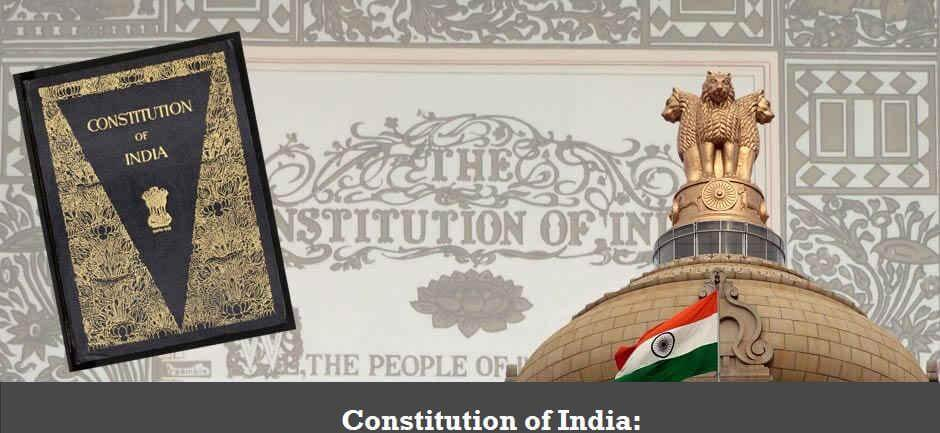
DAY 1 : MAKING OF THE CONSTITUTION OF INDIA
Let us first understand what is a constitution?
A Constitution is a legal document with the force of law that defines the structure of the government in a given country and the relationship between a government and the people.
A Constitution may also define how the country will relate with other countries and with foreigners.
A Constitution should reflect the ideals and aspirations of the country and articulate the values that bind its people and discipline its government. A Constitution is the supreme law of the land and the standard against which the legality of all laws is tested. Consequently, any law which conflicts with any of the provisions of the Constitution is invalid and has no force. Such a law is declared ‘ultra vires’.
Ultra vires: Ultra vires is a Latin phrase meaning literally “beyond the powers”.
It means beyond one’s legal power or authority.
Our Constitution was adopted on 26th November 1949 and came into effect on 26th January 1950.
After this day, it is being celebrated as the Republic day.
January 26 was deliberately chosen as the formal date of adoption of the Constitution because it was on that day in the year 1930 that the Indian National Congress led by Jawaharlal Nehru had symbolically declared ‘Poorna Swaraj’ (complete independence) from Britain.
National movements played a major role in popularizing the essence of basic notions like democracy, social and economic justice, republicanism, civil liberties as an essential principle of the constitution.
Indian National Congress born in 1885 actually started working systematically from 1920 onwards with the efforts of Gandhiji, who modified the Constitution of the Congress to be based on the elective principle.
In 1895, Constitution of India Bill, also called as Home Rule Bill appeared which conceived of basic human rights such as freedom of expression, equality before law, right to property, etc.
Congress-League pact of 1916 brought out the Congress-Muslim league scheme for constitutional reforms that demanded fourt–fifths of the members of the provincial legislatures to be elected by the people.
The reforms of 1919 introduced by British asserted that the timing and pace of constitutional reforms will be decided by British only.
Motilal Nehru introduced a resolution in the Central Legislative Assembly on 8 February 1924 which asked government to summon, at an early date, a representative Round Table Conference to recommend, with due regard to protection of the rights and interests of important minorities, ‘the scheme for constitution of India’.
This resolution came to be known as ‘National Demand’ and was passed by a large majority in Central Legislative Assembly.
Lord Birkenhead, the Secretary of State, in his speech delivered on 7th July, 1925 asserted that:
“Let them produce a constitution which carries behind it a fair measure of general agreement amongst the great people of India” challenging Indians to form their own Constitution.
Responding to Birkenheads’ challenge, All India Congress Conference in May 1928 appointed a Committee under Motilal Nehru to determine the principle of the constitution for India.
The Nehru Report submitted on 10th August 1928 effected an outline of a draft constitution for India.
It was the first major attempt by Indians to draft a constitutional framework for the country.
Main recommendations of Nehru Report:
- Dominion status on lines of self governing dominions as the form of government desired by Indians.
- A demand for joint electorates with reservation of seats for Muslims at the Centre and Provinces where they were in majority.
- Rejection of separate electorate.
- Nineteen fundamental rights out of which ten were incorporated in the Constitution.
- Demand for linguistic provinces.
- Full protection to cultural and religious rights of Muslims.
- Complete dissociation of the State from religion.
- Indian Parliament at the Centre to consist of a 500 member ‘House of Representatives’ elected on the basis of adult suffrage.
- In 1934, the idea of a Constituent Assembly was put forward for the first time by Manabendra Nath Roy.
- In 1935, INC officially demanded for the first time a Constituent Assembly.
- The demand for Constituent Assembly was also contained in the 1936-1937 election manifesto of Congress.
- In August 1937, a Congress Working Committee accepted a draft resolution prepared by Acharya Kripalani which demanded that the Government of India Act 1935 be repealed.
So what is a Constituent Assembly?
A Constituent Assembly (sometimes also known as a Constitutional Convention or Constitutional Assembly) is a body composed for the purpose of drafting or adopting a constitution.
A Constituent Assembly is usually set up for its specific purpose, which it carries out in a relatively short time, after which the assembly is dissolved.
In 1940, ‘August offer’ made by Viceroy Linlithgow for the first time conceded that the framing of the new constitution should be primarily (though not solely) the responsibility of the Indians themselves.
In March 1942, in the wake of the British collapse in Southern Asia during World War II, Sir Stafford Cripps was sent to India with a draft declaration on the proposals of the British Government which were to be adopted(at the end of the war) provided the two major political parties (Congress and the Muslim League) could come to an agreement to accept them,viz :
a) The Constitution of India was to be framed by an elected Constituent Assembly of the Indian people;
b) The Constitution should give India Dominion status, equal partnership of the British Commonwealth of Nations;
c) There should be one Indian Union comprising all the Provinces and Indian States; but
d) Any province (or Indian State) which was not prepared to accept the constitution would be free to retain its constitutional position existing at that time and with such non-acceding provinces the British government could enter into separate constitutional arrangements.
But the two parties failed to come to an agreement to accept the proposals, and the Muslim League urged :
a) That India should be divided into two autonomous States on communal lines, and that some of the provinces, earmarked by
Mr. Jinnah, should form an independent Muslim state, to be known as Pakistan;
b) Instead of one constituent assembly, there should be two Constituent Assemblies, i.e., a separate Constituent Assembly for building Pakistan.
After the rejection of Cripps proposals, various attempts to reconcile the two parties were made including Simla Conference held at the instance of the Governor General, Lord Wavell.
These having failed, British cabinet sent three of its own members including Cripps himself, to make another serious attempt.
On 19 February 1946, British government sent a ‘Cabinet Mission’ to India to resolve the whole issue of freedom and constitution-making.
The mission consisted of
1) Lord Pethick Lawrence, the Secretary of State for India
2) Sir Stafford Cripps, President of the Board of Trade
3) A. V. Alexander, the First Lord of the Admiralty
Lord Wavell, the Viceroy of India, did not participate.
The mission put forward the scheme of Constituent Assembly which more or less satisfied Muslim league.
Composition of Constituent Assembly
- It was constituted under the scheme formulated by Cabinet Mission known as the Cabinet Mission plan.
- Total strength was to be 389 (a) 296 seats to be allotted to British India – 292 members to be drawn from the eleven governors province – 4 members from the four chief commissioners provinces, one from each (b) 93 seats for the Princely states.
- Seats in each province and princely states to be allotted according to their population. Roughly one seat was to be allotted for every million population.
- Seat allocation to each British province were to be decided among three principle communities -Sikh ,Muslim and general (all except Muslim and Sikh) in proportion of their population.
- Voting is to be done by the method of proportional representation by means of single transferable vote.
- Nomination of the representatives of Princely states to be done by the heads of the Princely states.
- Election to the Constituent Assembly (for 296 seats allotted to British Indian provinces) was held in July –August in 1946. 208 seats were won by Indian National Congress
– 73 seats by Muslim league
– 15 seats by independent candidates
– 96 seats fell vacant as the Princely states decided to stay away from election
First meeting of Constituent Assembly was held on 9th December 1946.
It was attended by only 207 members.
The Muslim league having failed to prevent the convening of the Constituent Assembly, refused to join it.
Dr. Sachidanand Sinha, the oldest member was elected as the temporary head of the Assembly, following the French practice.
On December 11, 1946, Dr. Rajendra Prasad and H.C.Mukherjee were elected as the President and Vice President of the assembly respectively.
Sir B.N.Rao was appointed as the constitutional advisor to the Assembly.
Objectives Resolution:
Jawahar Lal Nehru moved the historic resolution on 13th December 1946.
The objectives laid down the fundamentals and philosophy of the constitutional structure.
This resolution was debated till 19th December but its adoption was postponed to enable the Muslim League representatives and princely states to join.
At the next session, this resolution was adopted by the Assembly on 22nd January 1947.
With India becoming independent, the Constituent Assembly became a sovereign body and the legislature for the new state.
The work of constituent assembly was organized into five stages:
(1) Committees were asked to present reports on basic issues.
(2) B.N .Rao, the constitutional advisor, prepared an initial draft on the basis of reports of these Committeesand his own research into the constitution of different countries.
(3) Drafting Commiittee, chaired by Dr B.R. Ambedkar, presented a detailed draft constitution which was published for public discussion and comments.
(4) Draft Constitution was discussed and amendments proposed.
(5) Adoption of the Constitution.
Committees of the Constituent Assembly:
Some of the important committees of the Constituent Assembly were as under
| Committees | Minister in charge |
| (1) Union Powers Committee | Jawahar Lal Nehru |
| (2) Union Constitution Committee | Jawahar Lal Nehru |
| (3) Provincial Constitution Committee | Sardar Patel |
| (4) Drafting Committee | Dr. B. R. Ambedkar |
| (5) Advisory Committee on Fundamental Rights and Minorities Two Sub Committees (a)Fundamental Rights Sub Committee (b)Minorities Sub Committee | Sardar Patel J.B. Kripalani H.C.Mukherjee |
| (6) Rules of Procedure Committee | Dr. Rajendra Prasad |
| (7) States Committee(Committee for negotiating with states) | Jawahar lal Nehru |
| (8) Steering Committee | Dr. Rajendra Prasad |
| (9) North-East Frontier Tribal Areas and Assam Excluded & Partially Excluded Areas Sub-Committee | Gopinath Bardoloi |
| (10) Excluded and Partially Excluded Areas (Other than those in Assam)Sub-Committee | A.V. Thakkar |
Some minor Committees were as under: Committees In charge minister |
Drafting Committee:
It was the most important Committee among all. It was set up on 29th August, 1947.
It consisted of seven members
- Dr. B. R. Ambedkar (Chairman)
- N. Gopalaswamy Ayyar
- Alladi Krishnaswamy Ayyar
- Dr. K. M. Munshi
- Syed Mohammed Saaddullah
- N. Madhav Rao (he replaced B L Mitter who resigned due to ill health)
- T. T. Krishnamachari (he replaced D P Khaitan who died in 1948)The first draft was published in February 1948.
Eight months time was given to discuss and propose amendments.
Second draft was published in October 1948.
Final draft was introduced on November 4, 1948.
| Provisions of the Constitution and Their Source | |
| Independence of Judiciary Judicial Review President as the Executive head President as the Supreme Commander of the Armed Forces Vice-President as the ex-officio Chairman of the Council of States,Fundamental Rights Preamble Removal of Supreme Court and High Court Judges | USA Constitution |
| Law making procedure Rule of Law System of Single Citizenship Parliamentary system with ministerial responsibility | UK Constitution |
| Federation with a strong centre, Distribution of powers between the Union and the States and placing the residuary powers with the Centre | Canadian Constitution |
| Directive Principles Method of election of the President Nomination of the members of the Rajya Sabha by the President | Irish Constitution |
| Emergency and its effect on Fundamental Rights | Weimar Constitution of Germany |
| The Concurrent List, Provision regarding trade, commerce and intercourse | Australian Constitution |
| Constitutional Amendments | African Constitution |
| Fundamental Duties | Japan Constitution |
| Republic | French Constitution |
Enactment of the Constitution:
It was introduced for the first reading on November 4, 1948. Second reading started on 15th November 1948 and ended on October 1949.The Third reading started on November 14, 1949.
Dr. B. R. Ambedkar moved a motion- ‘the constitution as settled by the assembly be passed ‘.
The motion on draft constitution was declared as passed on November 26, 1949.
Out of the total 299 members only 284 were present and signed the constitution.
The Constitution was adopted on 26th November, 1949, which contained a Preamble, 395 Articles and 8 Schedules.
Dr.B.R. Ambedkar is regarded as the Father of the Constitution.
There was a mention of a term ‘motion’ in the preceding lessons, any idea what does it mean?
In parliamentary procedure, a motion is a formal proposal by a member of a deliberative assembly that the assembly take certain action.
Simply put, a motion puts into ‘motion’ some action i.e. initiates certain action.
Let us now get familiar with the term ‘article’.
Here is the literary meaning of an article.
Article (Noun): A particular section or item of a series in a written document, as in a contract, constitution, or treaty.
Heard about ‘schedules’ in the Constitution? Let us understand what they are?
Here is the literary meaning of a schedule.
It is the supplementary statement of details appended to a document.
Criticism of the Constituent assembly:
- It was not a representative body – As its members were not directly elected by the people of India on the basis of universal adult franchise.
- It was not a sovereign body – As it was created by the proposals of the British Government.
- It was dominated by Congress – Majority members were from Congress party.
- According to Granville Austin – ‘The Constituent Assembly was a one party body in an essential one party nation. The Assembly was Congress and the Congress was India’.
- It was time consuming. It took a long time to frame it. (2 years, 11 months, 18 days to be precise).
- It was dominated by lawyers and politicians – Other sections of the society were not sufficiently represented.
- It was dominated by Hindus – Lord Viscount Simon called it ‘a body of Hindus’.
An apt repeated criticism of the Constitution of India is that there is nothing unique in it and most of the provisions have been copied from either the previous acts of the British Government or the constitution of other countries.
While it is true that the provisions of the previous acts of the British Government were retained, it should also be added that only those provisions were retained which were deemed necessary for the country.
Similarly, while provisions from various constitutions around the world were looked at, it would be wrong to conclude that they were being copied from those constitutions.
A proper analysis of the features that we have borrowed from other countries would enlighten the reader that the provisions were debated rigorously in the Constituent Assembly and modified to suit the Indian context.
Day 2nd short Notes of Polity click : 2nd Day Short Notes
Join Telegram Channel – https://t.me/FundamentalIAS
 fundamentalias.school.blog
Great notes sir
LikeLike