
UNIVERSE AND THEORIES AND SOLAR SYSTEM AND OTHER CELESTIAL BODIES
The Universe
Stars occur in clusters described as galaxies or nebulas.
Earth is also one of the star in a galaxy known as Milky way which contains 1 lakh million stars (1 million = 10 lakh).
A ray of light from the sun takes about 8 minutes to reach the earth.
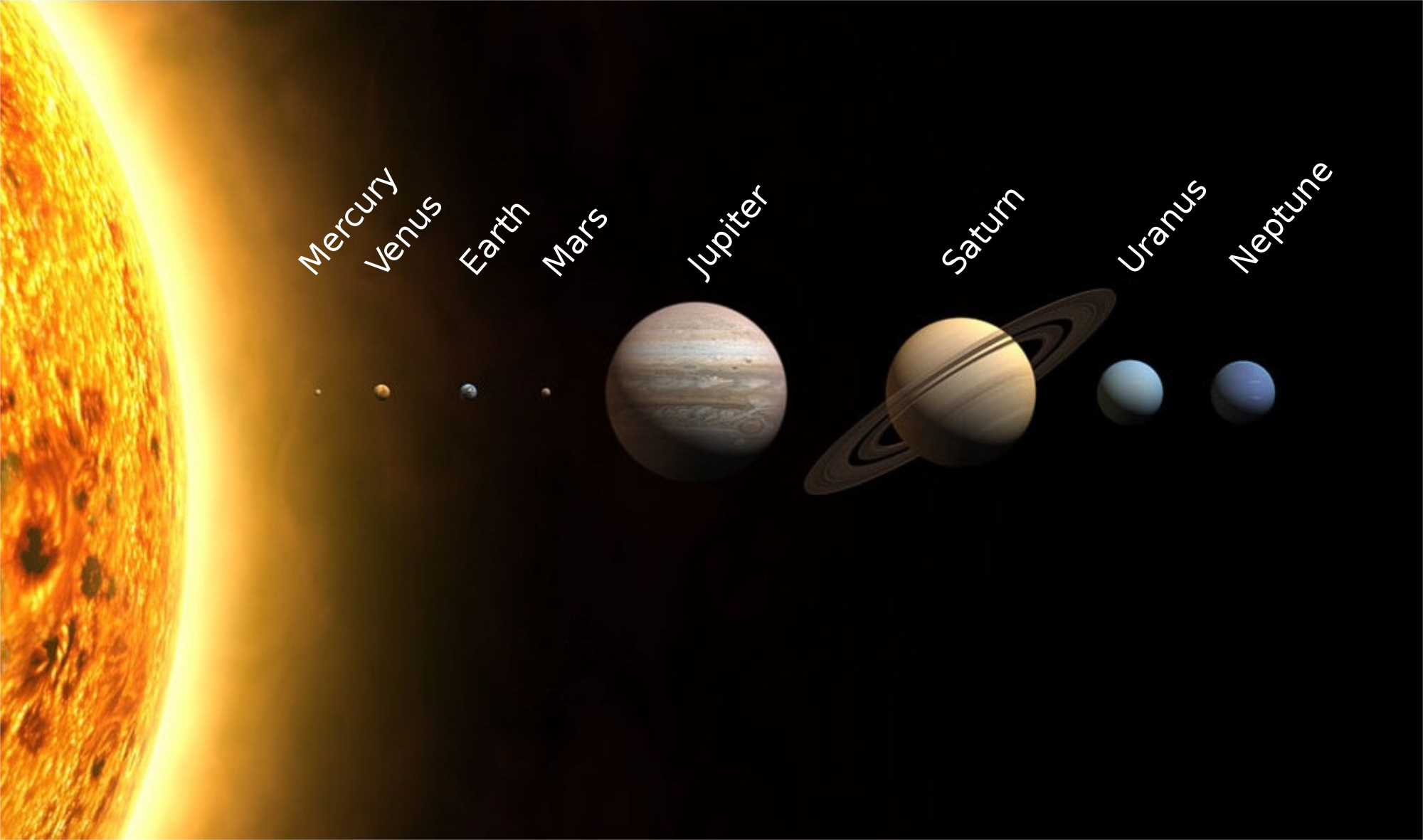
Our solar system consists of Sun and 8 planets which are revolving around the sun in elliptical orbits.
The planets are believed to have been developed from the condensation of gases and other lesser bodies.
The Sun has a surface temperature of 6000 degree centigrade.
SUN —-> MERCURY —-> VENUS —-> EARTH —-> MARS —-> JUPITER —-> SATURN —-> URANUS —-> NEPTUNE
Mercury is the smallest and closest to the Sun.
A year in Mercury is only 88 days.
Venus is similar to Earth in its size, mass and density. So it is called as ‘Earth’s twin’.
Jupiter is the largest planet in our solar system. It has circular light and dark bands on its surfaces due to various gases.
Saturn has three rings around it.
All planets revolve around the Sun in anti-clockwise direction. Uranus is the only planet which orbits in clockwise direction from East to West.
The universe is defined as the totality of existence including galaxies, stars, planets, the contents of intergalactic space and all matter and energy. There are various theories about the origin of the universe, among which ‘The Big Bang Theory’ is widely accepted which was given by Belgain astronomer Abbe Georges Lemaitre.
It is also called expanding universe hypothesis. According to the theory, in the beginning, all matter forming the universe existed in one place in the form of a “tiny ball” with an unimaginably small volume, infinite temperature and density. At the Big Bang the ‘tiny ball’ exploded violently leading to a huge expansion.
The expansion continues even to the present day. As it grew, some energy was converted into matter.
It is accepted that the ‘big bang’ took place about 14 billion years ago.
Milkyway is the galaxy in which our solar system is located. Andromeda is the nearest galaxy to the milkyway.
The diameter of Milky Way galaxy is said to be around 120,000 light years.
A light year is a measure of distance and not of time, it is the distance travelled by the light in one year. Light travels at a speed of 300,000 kilometres per second.
Considering this, the distance the light will travel in one year equals to
300000*(365*24*60*60) = 9.461*1012 kilometres ( 9,460,000,000,000 kilometres)
The distance between the Sun and the Earth is 149,598,000 kilometres (15 crore kilometres approximately).
This distance is also called 1 A.U. (Astronomical Unit) and is used to measure large distances in the solar system.
A ray of light from Sun takes around 8.31 minutes to travel this great distance and reach the earth.
Stars are formed when localized clumps of gas in a growing nebula continue to grow into even denser gaseous bodies.
The formation of stars is believed to have taken place some 6 billion years ago.
Stars are not spread uniformly across the universe, but are normally grouped into galaxies along with interstellar gas and dust.
The Sun is the nearest star to the earth, and then comes the Proxima Centauri.
Why do stars twinkle where as planets and the moon do not?
The scientific name for the twinkling of stars is stellar scintillation (or astronomical scintillation).
Stars twinkle when we see them from the Earth’s surface because we are viewing them through thick layers of turbulent (moving) air in the Earth’s atmosphere.
Planets and the moon do not usually twinkle, because they are so close to us; they appear big enough and the light reflecting from them is refracted less by the pockets of air in the turbulent upper atmosphere.
How can one locate directions at night without using a compass?
For many thousands of years, Polaris (also known as the North Star or Pole Star) has been used as a guiding star and reference point for navigators and astronomers.
The North Star is so important because it does not appear to move in the night sky. Therefore we can navigate by it.
A constellation is a group of stars that, when seen from Earth, form a pattern.
The stars in the sky are divided into 88 constellations.
Out of the 88 modern constellations, 36 lie predominantly in the northern sky, and the other 52 predominantly in the southern.
The brightest constellation is Crux (the Southern Cross).
The constellation with the greatest number of visible stars in it is Centaurus (the Centaur – with 101 stars).
The largest constellation is Hydra (The Water Snake)
A huge rotating disc of gas and dust develops around the gas core of a star.
This gas cloud starts getting condensed and matter around the core develops into small rounded objects which are transformed into planetesimals.
Finally these large number of planetesimals accrete to form a fewer large bodies in the form of planets. These planetary bodies revolve around the stars.
Asteroids
Asteroids are essentially chunks of rock that measure in size from a few feet to several kilometres in diameter.
There are millions of asteroids which orbit our Sun.
Asteroids are also called planetoids, especially the larger ones.
The largest asteroid by far is Ceres. It is 914 km across and contains about 25% of the mass of all the asteroids combined! In 2006 it was recognized to be a dwarf planet.
The asteroid belt is a region of the solar system falling roughly between the planets Mars and Jupiter. Most of the asteroids orbit between Mars and Jupiter in a grouping known as the Main Asteroid Belt.
Many asteroids lie outside the main belt.
For instance, a number of asteroids called Trojans lie along Jupiter’s orbital path.
Three groups — Atens, Amors, and Apollos — known as near-Earth asteroids orbit in the inner solar system and sometimes cross the path of Mars and Earth.
Meteoroids
Meteoroids are smaller than asteroids; most are smaller than the size of a pebble.
Most meteoroids come from asteroids that are broken apart by impacts with other asteroids.
Other meteoroids come from the moon, from comets, and from the planet Mars.
When a meteoroid enters the earth’s atmosphere, it burns up because of frictional heating.
The heat causes gases around the meteoroid to glow brightly.
This glowing meteoroid is called a meteor (commonly known as a “shooting star”).
If the meteoroid doesn’t burn up completely and strikes the Earth we call it a meteorite.
Kuiper Belt
The Kuiper Belt is a region of space in our solar system, shaped more like an ellipse than a circle, which is similar to an asteroid belt.
While the asteroid belt is mostly metal and rock, the Kuiper Belt is composed almost entirely of icy chunks of various substances.
Actually, the makeup of Kuiper Belt Objects is similar to the composition of comets – a mixture of frozen water, ammonia and various hydrocarbons, such as methane.
Comets
Comets are cold clumps of rock and ice that grow tails as they approach the sun in the course of their highly elliptical orbits.
When a comet nears the Sun, its ice vaporizes.
A mix of ice and dust is pushed away from the comets by solar winds, forming a long tail.
The tail always points away from the Sun.
The sun illuminates this trail, causing it to glow. The glowing trails are visible in the night sky.
Our Solar System
Our solar system is supposed to be formed about 5-5.6 billion years ago and the planets were formed about 4.6 billion years ago.
It comprises of the Sun (the star), 8 planets, 166 moons, millions of smaller bodies like asteroids and comets and huge quantity of dust grains and gases.
The Inner Planets: Mercury, Venus, Earth and Mars are called as the inner planets as they lie between the Sun and the asteroid belt. These are earth-like as they are made up of rock and metals, and have high densities.
The Outer Planets: Jupiter, Saturn, Uranus and Neptune are the outer planets which are also called the Gas Giants or Jovian planets because of their similarities to the Jupiter. They are formed of lighter and gaseous material.
Why are inner planets rocky while the outer planets are mostly gaseous?
The inner planets were formed in the close vicinity of the Sun where it was too warm for gases to condense to solid particles and the solar wind which was intense near the sun blew off lots of dust and gas from the terrestrial planets.
The solar winds were not that intense to cause a similar removal of gases from the Jovian planets.
The inner planets being smaller and having lower gravity could not hold the escaping gases.
Sun- Mercury, Venus, Earth, Mars, Jupiter, Saturn, Uranus and Neptune
Mnemonic: My Very Eager Mom Just Served Us Noodles
The Sun
The Sun is by far the largest object in the solar system.
It contains more than 99.8% of the total mass of the solar system.
The Sun is, at present about 71% hydrogen and 27% helium by mass.
This composition changes slowly over time as the hydrogen is converted to helium by the process of nuclear fusion in the core of the Sun. The temperature in the core is believed to be 15,000,000 C.
The surface of the Sun is called ‘photosphere’. The temperature here is around 5500o C.
We can see some dark patches on the photosphere which are called ‘Sun Spots’.
The Sun Spots are relatively cooler areas on the solar surface.
During an eclipse, we can see a red circle on the outside of the Sun, which is called Chromosphere.
The outer most layer of the Sun is called ‘Corona’
A solar flare is a magnetic storm on the Sun which appears to be a very bright spot and a gaseous surface eruption.
Solar flares release huge amounts of high-energy particles and gases and are tremendously hot.
They are ejected thousands of miles from the surface of the Sun.
Solar Wind
The solar wind is a continuous stream of ions (electrically charged particles) that are given off by magnetic anomalies on the Sun.
It takes the solar wind about 4.5 days to reach Earth; it has a velocity of about 400 km/sec.
When the radiation and the particles of solar flares and solar wind reach the Earth’s magnetic field, they interact with it at the poles to produce the auroras (aurora borealis-north pole and aurora australis-south pole).
Mercury
Mercury is the planet nearest to the sun. It rotates on its own axis in 56.65 earth days.
It takes 88 days to complete one revolution round the sun.
Thus it is the fastest planet in our solar system.
Venus
Also known as the evening star and the morning star, it is the brightest object in the sky after the Sun and the Moon.
It is slightly smaller than the earth and is the planet closest to the earth.
It is also the hottest planet in our solar system.
Earth
The earth is the only planet in the solar system which can sustain life.
Earth is the third planet from the Sun, and the densest and fifth-largest of the eight planets in the Solar System.
It is also the largest of the Solar System’s four terrestrial planets.
It is also known as the blue planet.
Mars
Mars is the fourth planet from the Sun and is the next planet after the earth.
Named after the Roman god of war, it is often described as the “Red Planet” because the iron oxide prevalent on its surface gives it a reddish appearance.
It has two small satellites called Phobos (Fear) and Deimos (Terror).
Jupiter
Jupiter is the largest planet in our solar system.
It is about eleven times larger than the earth.
It is two and a half times the mass of all the planets combined together.
The most conspicuous aspect about Jupiter is its Great Red Spot seen on its surface.
Jupiter has the largest number of satellites(63).
Saturn
Saturn is an outer planet visible to the naked eye.
Second in size to Jupiter, it is the least dense of all the planets.
The most spectacular feature of Saturn is its system of rings.
The ring system is made up of a variety of separate particles which move independently in circular orbits.
It has 62 satellites. Titan is its biggest.
Uranus
Uranus is the seventh planet from the Sun and is not visible to the naked eye.
It has completed only two revolutions round the sun since its discovery, and takes about 84 terrestrial years to circle round the sun.
It has 27 satellites.
Neptune
Neptune is not visible to the naked eye but can be seen through a small telescope as a greenish star.
It is eighth in position from the sun.
It has thirteen satellites; Triton and Nereid are the most conspicuous of them.
Some facts about the Solar System
- Planets in the order of decreasing size
Jupiter, Saturn, Uranus, Neptune, Earth, Venus, Mars, Mercury.
- Earth is the densest body of the solar system followed by Mercury, with Saturn having the least density.
- Unlike other planets, Venus rotates from east to west.
- Jupiter has the fastest rotational velocity and Venus being the slowest.
- The period of revolution around the Sun increases with the increasing distance from the sun. Therefore Mercury takes 88 days to revolve around the sun where as Neptune takes 165 years.
- Venus(475 C) is the hottest planet and Neptune is the coldest(-228 C)·
- Mercury and Venus do not have moons (natural satellites).·
- Earth has a moon.
- Mars has two moons (Phobos and Deimos)
- Neptune-13
- Uranus-27
- Saturn-62
- Jupiter-67
The Moon
The Moon is the only natural satellite of the earth.
Its size is one-eighth of the size of the earth. Its gravity is one sixth of the earth’s gravity.
It is the largest natural satellite of a planet in the solar system.
The Moon rotates on its own axis in exactly the same time as it revolves, therefore we always see the same side of the moon.
It is at a distance of 3,84,400 km. The moonlight takes only 1.3 seconds to reach the earth.
The moon has mountains, highlands and low lying plains. It has sharp peaked mountains of which Leibnitz Mountains is 10660 metre high.
Planetary Rings
A planetary ring is a ring of cosmic dust and other small particles orbiting around a planet in a flat disc-shaped region.
The most notable planetary rings known in the Solar System are those around Saturn, but the other three gas giants of the Solar System (Jupiter, Uranus and Neptune) also possess ring systems of their own.
 fundamentalias.school.blog