
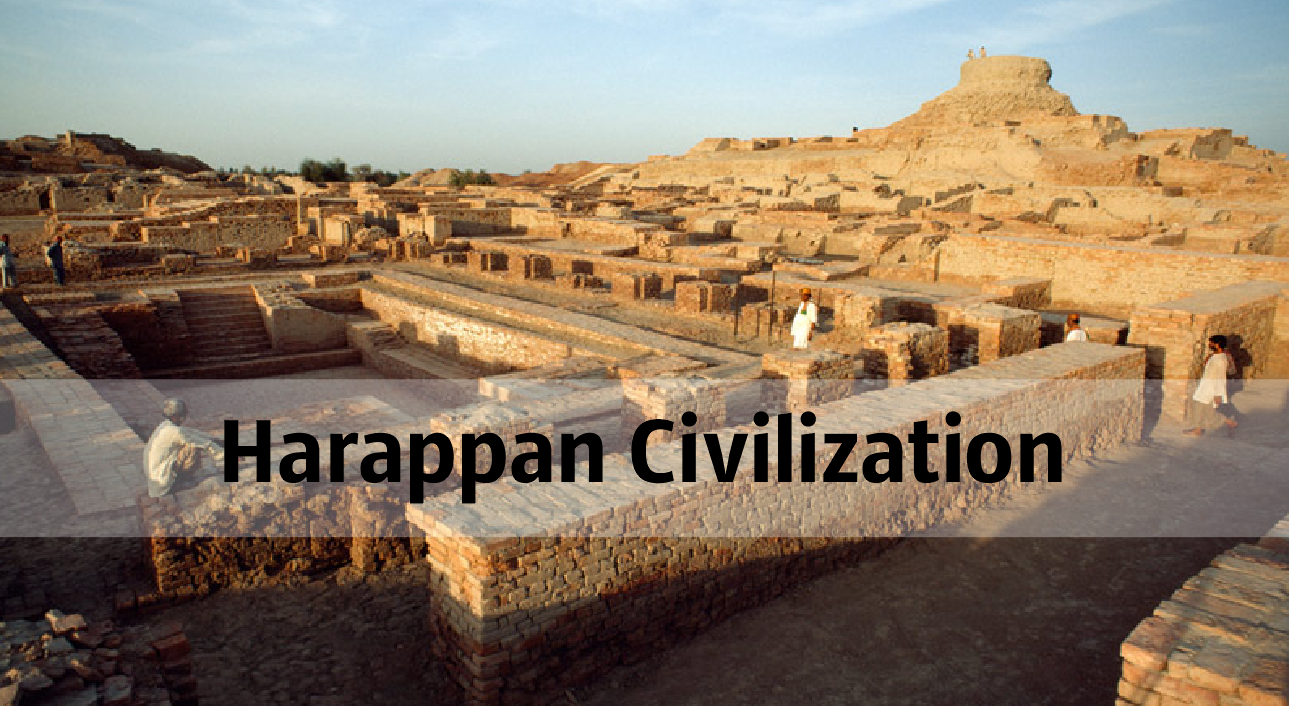
Harappan Civilization
Material remains like coins, inscriptions, etc and literary sources are used to reconstruct history.
Human beings have been living in India roughly from 5,00,000 BC which corresponds to the old stone age.
The old stone age or Paleolithic culture of India developed in the Pleistoscene period or Ice age.
This period comes immediately before Holocene, the period in which we live today.
Holocene started 10,000 years ago.
The old stone age or the Paleolithic age is sub divided into three phases
1. Lower Paleolithic
2. Middle Paleolithic
3, Upper Paleolithic
Human beings (Homo Sapiens) first appeared in the Upper Paleolithic age.
The Upper Paleolithic Age came to an end with the end of the Ice age around 8000 B C.
Neolithic period or New Stone Age started around 7000 B C.
Towards the end of neolithic period began the use of metals.
The metal to be used first was Copper. This is the beginning of Chalcolithic period.
More detailed study of these is not worth it from the UPSC Prelims Perspective.
The Indus Valley Civilization was a Bronze Age civilization that was located in the northwestern region of the Indian subcontinent.
The civilization was discovered first in 1921 at the modern site of Harappa situated in the province of West Punjab in Pakistan.
The Harappan culture covered parts of Punjab (undivided India), Sindh, Balochistan, Gujarat, Rajasthan and some parts of Western Uttar Pradesh.
It extended from Jammu in the north to the Narmada estuary in the south, and from the Makran coast of Balochistan in the West to Meerut in the north-east.
Two most important cities were Harappa in Punjab and Mohenjodaro in Sindh, both forming parts of Pakistan.
Harappa’s pre-eminent position was linked to its ability to procure exotic items from far away lands.
The city Mohenjo-Daro was discovered in 1922 by R.D.Banerjee and Sir John Marshall on the river Indus in Sindh, which is the largest site of the Harappan Civilization.
Since most of these cities were located along river Indus, it came to be known as Indus valley civilization.
It was called a civilization because the people were living a more advanced life with well planned cities than those of the previous primitive ages.
The Harappan people knew how to write and their language was written in picture-like signs called ‘pictographs’. However, their script has not been deciphered till date.
From the inscriptions on the seals, pottery and other objects, it is clear that the Indus people knew reading and writing.
The use of weights and measures proves that they knew arithmetic as well.
The script which has not been deciphered but some believe that writing was boustrophedon or from right to left and from left to right in alternate lines.
The Harappan People had trading contacts with the people of Sumer (a town in Southern Iraq).
The cities of Mohenjo-Daro and Harappa were divided into two parts:
- The upper part built on the raised platforms as been described as the ‘Citadel’. A Citadel is a fortified structure designed to provide protection during the battle. It is typically one on high ground above a city. This part included the public buildings, granaries, the Great Bath, more important workshops and religious buildings.
- The lower part of the city was much larger where the people lived and carried their professional work.
Whenever the city was attacked or threatened by floods, the inhabitants of the lower city found refuge in the citadel.
Among the well known buildings of Harappa are the granaries. They were neatly laid out in rectangles and lay close to the river.
The Great Bath is one of the best-known structures among the ruins of the ancient Indus Valley Civilization at Mohenjo-Daro in Sindh, Pakistan.
The Great Bath of Mohenjo-Daro is called as “the earliest public water tank of the ancient world”.
- This brick built structure measures 12m x 7m and is about 3 m deep.
- It is approached at either end by flights of steps.
- The bed of the bath was made water tight by the use of bitumen.
- Water was supplied by a large well in an adjacent room.
- There was corbelled drain for disgorging water too.
- The bath was surrounded by porticoes and sets of rooms.
There was also an arrangement to send a hot water to pool.
The lower city of Mohenjo-Daro was carefully planned before the houses were built.
Here, the streets ran straight and at right angles to each other.
Streets were wide, the main street being 10 meters wide, which is as wide as many of the large streets in modern cities.
Houses were built on both sides of street. Many houses were at least two storied.
Apart from sheep and goat, humped cattle seem to have been domesticated.
Bones of boars, buffaloes, elephants and camels have also been found from many settlements.
Horse seems to be unknown to Harappan people.
Barley and wheat seem to have been widely grown.
Representations on seals and terracotta sculpture indicate that the bull was known, and archaeologists extrapolate from this that oxen were used for ploughing.
Moreover, terracotta models of the plough have been found at sites in Cholistan and at Banawali (Haryana).
Archaeologists have also found evidence of a ploughed field at Kalibangan (Rajasthan), associated with Early Harappan levels.
The field had two sets of furrows at right angles to each other, suggesting that two different crops were grown together.
Toys for children
- Small clay carts resembling the modern ekkas, which were probably copies of the carts drawn by oxen in which people travelled.
- Whistles made in the form of birds and rattles of all kinds.
- Marbles for children, dolls for girls were also popular.
The older people enjoyed gambling.
The most famous art piece from the Harappan Civilization is the bronze dancing girl discovered in Mohenjodaro.
With head drawn backwards, drooping eyes and the right arm on the hip and the left arm hanging down, the figure is in a dancing stance.
She is wearing a large number of bangles, and her hair is plaited in an elaborate fashion.
Making of beads and amulets was also popular. Beads were made of clay, stone, paste, shell and ivory.
Seals were made of Steatite.
The seal has a design on one side, usually the picture of a bull, or a tree, or some scene and above the picture is a line of pictographs (the picture like signs used as a script by the Harappan people).
Merchants and traders used these seals to stamp their goods.
This was similar to the trademark concept that we have today.
Harappan people had trade contact with the people in the Sumer and in the towns lying along the Persian Gulf. It is evident by seals and objects found at sites in Iraq and other countries of West Asia.
Lothal was major centre for shipping of merchandise. (Lothal is located in the coastal flats of the Gulf of Cambay).
Archaeologists believe that Dholavira (a Harappan site in present day Gujarat) was an important centre of trade between settlements in south Gujarat, Sindh , Punjab and Western Asia.
Weights and measures have been found in various shapes and very accurately graded.
They were cubical and spherical in shape and were made of chert, jasper and agate. The weights proceeded in a series, first doubling from 1, 2, 4, 8 to 64 and then in decimal multiples of 16.
The tradition of 16 or its multiples continued in India till 1950s.
There were also trade contacts with people of northern Afghanistan from where the Harappans brought the famous Blue gemstones: Lapis Lazuli.
The following evidences suggest that their religion was mainly of an indigenous growth and was the lineal progenitor of Hinduism.
- Clay figures of Mother Goddess.
- A seated figure of a male God, carved on a small stone seal. This image is believed to be that of Pashupati Shiva. This male deity is surrounded by- elephant, tiger, buffalo, rhinoceros & deers.
- Pipal tree seems to be sacred, which is often shown on the seals.
- Bull was believed to be sacred.
Swastik symbol is also found at certain places.
An artifact called the Priest King was found at the Mohenjo-Daro archaeological site, Sindh Province Pakistan. It is the iconic representation of Indus civilization.
A large number of terracotta figurines depict the individuals in various yogic posture (asanas) indicating practice of Yoga by Harappans
Some of the Harappan people buried their dead in graves, others practiced urn-burial.
Urn burial is a kind of burial in which a pottery vessel is used as a grave repository for the ashes and bones of the corpse.
The people of Harappa must have believed that there was life somewhere even after death because the graves often contained household pottery, ornaments and mirrors, which may have belonged to the dead person and which, it was thought, he or she might need after death.
| Site | Importance |
| Harappa | Copper chariotCemeteryGold braceletTrade contact with Mesopotamia |
| Mohenjodaro | Bronze dancing girlGranaryThe Great bath |
| Lothal | DockyardRice huskGame similar to chess |
| Chanhudaro | Shell and bead ornamentsLipstick |
| Surkotada | Remains of horse |
| Kalibangan | Wooden furrowFire altarsOrnamental bricksEvidences of ploughed fieldsBurnt/Baked Bangles |
| Ropar | Dog buried with master |
| Rangpura | Rice husk |
| Banawali & Cholistan | Teracotta models of plough |
The Harappan culture lasted for about more than thousand years.
Harappan culture had collapsed by 1500 B.C, when the Aryans began to arrive in India.
The reasons for collapse are not definitive. The following may be the probable causes for the decline of Harrapan culture :
- It may be the floods, which came regularly; or
- There may have been an epidemics or some terrible disease which killed the people.
- The climate also began to change and the region became more and more dry and like a desert; or
- The cities might have been attacked and the inhabitants unable to defend themselves.
 fundamentalias.school.blog